Eduardo Paolozzi


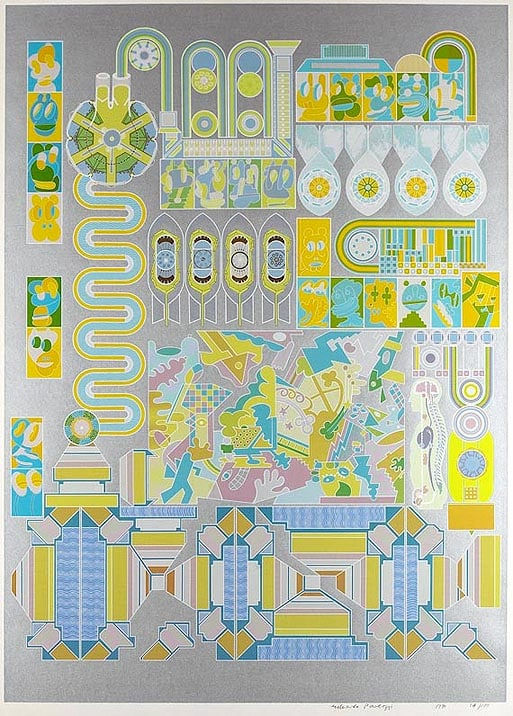
Sir Eduardo Paolozzi is widely regarded as one of the founding figures of British Pop Art — a polymath whose work spans sculpture, collage, printmaking, mosaic, and public art, and whose restless inventiveness reshaped postwar British art’s engagement with technology, mass culture, and the built environment. Born in Leith, Edinburgh, in 1924, Paolozzi was the son of Italian immigrants from Lazio; his early life was marked by wartime hardship, and in 1940 his father and other relatives were interned as “enemy aliens.”
Paolozzi studied at Edinburgh College of Art before moving to the Slade School of Fine Art (1944–47), and early in his career he spent time in Paris — a formative period during which he encountered the Surrealists and artists such as Giacometti, Arp, and Brâncuși. This continental influence left a deep imprint: from the late 1940s Paolozzi began experimenting with collage and found materials, combining fragments of adverts, sci-fi magazines, machine parts, and surreal imagery — gestures that would prefigure Pop Art’s embrace of mass media and consumer iconography.
In 1952 he co-founded the Independent Group, a collective whose theorising around media, technology, and popular culture helped shape the ideological foundations of what became British — and then global — Pop Art. His 1947 collage I Was a Rich Man’s Plaything is often cited as the first work to anticipate Pop Art’s concerns.
In the 1950s and early 1960s, Paolozzi’s practice expanded: he experimented with screenprints, pottery, mosaics, and graphic design. Alongside fellow artists and designers he established the design company Hammer Prints, producing wallpapers, textiles and ceramics which blended functional craft with avant-garde aesthetics — an early attempt to blur the boundaries between art, design, and everyday life.
Yet Paolozzi’s ambitions went beyond surface pattern: from the mid-1960s he turned increasingly to sculpture, welding, and casting. Embracing industrial materials such as aluminium and brass, he created geometric, often totemic forms whose metallic surfaces and monumental scale evoked machines, architecture, and the monstrous beauty of industrial modernity. Works such as Dollus II (1968), with its chrome-plated steel structure, demonstrate this turn.
Paolozzi’s public works remain among his most enduring achievements. His mosaics for the platforms and passages of London’s Tottenham Court Road station — commissioned in the 1980s and restored many times since — have become part of the urban fabric, embedding modern art in daily commuter experience. In 1995 he created Newton After Blake, a powerful bronze sculpture installed at the forecourt of the British Library, which merges scientific form, mythic symbolism, and his characteristic industrial aesthetic.
Paolozzi’s influence is profound and multifaceted: he helped define Pop Art, revitalised sculpture with new materials and machinery, and showed how to integrate fine art, design, craft, public space, and mass culture into a single practice. His work is held in major institutions worldwide — from Tate to MoMA — and his posthumous retrospectives, studio-recreation exhibitions, and catalogues continue to influence successive generations who seek to reconcile aesthetics, technology, and society.
Through his entire career, Paolozzi insisted on art’s capacity to reflect and shape the industrial and cultural realities of his time — but also to dream, to satirise, and to imagine new possibilities. His images of machines, fragments, and hybrid forms remain surprisingly current, reminding viewers how art can transform the familiar into the uncanny, the mundane into the monumental.
-
London Original Print Fair 2025, March 20 - 23
16 - 24 Mar 2025Booth W7 London Original Print Fair Somerset House, London, WC2R 1LA 19 March: Private View (by invitation only) 20 – 23 March: Open to the...Read more -

British Art Fair 2022
British Art Fair, Saatchi Gallery, Sep 29 - Oct 2 29 Sep - 2 Oct 2022I am delighted to be exhibiting for the first time at the British Art Fair at the Saatchi Gallery this September/October. I will be on...Read more -

London Original Print Fair 2022
W6, West Wing, Somerset House 26 - 29 May 2022I am delighted to be exhibiting at the 37th edition of the London Original Print Fair in its new location at Somerset House . I...Read more -

London Art Fair 2022
21 - 24 Apr 2022I am delighted to be back exhibiting at the 2022 London Art Fair . 'We believe that great art provides a lens to see the...Read more -
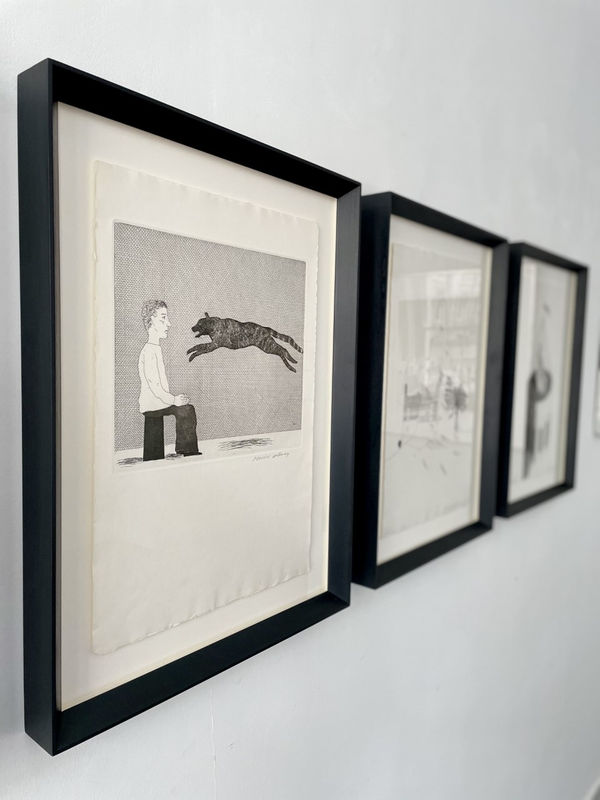
Prints & Fairy Tales: Austin / Desmond Fine Art & Julian Page, May 11-21
11 - 21 May 2021We will be extending our current exhibition Prints and Fairy Tales until 21 May. Curated in partnership with Austin Desmond, the show features a selection...Read more