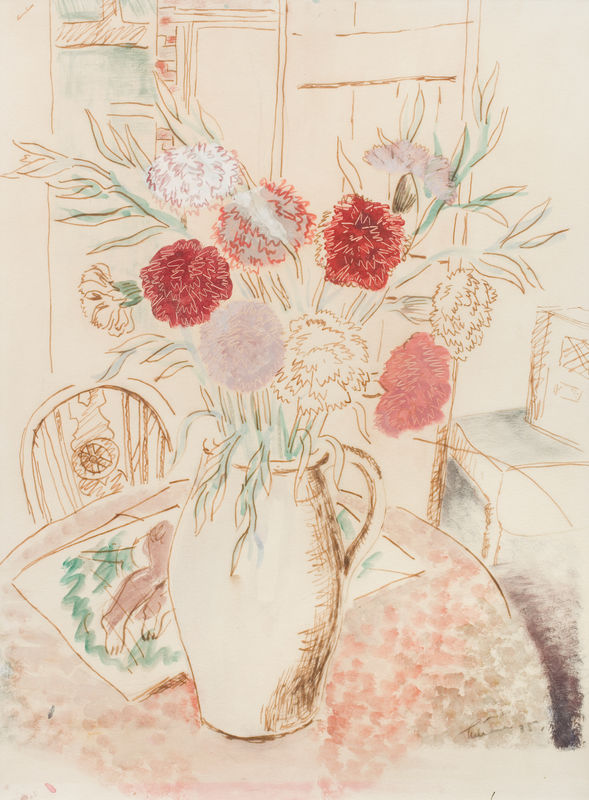
John Tunnard (1900-1971) was a distinctive British modernist painter whose luminous, dreamlike abstractions brought a uniquely poetic voice to twentieth-century art in Britain. Born in 1900 in Sandy, Bedfordshire, Tunnard initially trained not as a painter but as a designer. He studied at the Regent Street Polytechnic in London and later worked in commercial design, experiences that sharpened his sense of composition and surface. Yet it was painting that would become his lifelong vocation, and by the late 1920s he had committed himself fully to developing a personal visual language.
In the early 1930s, Tunnard settled in Cornwall, a move that proved transformative. The rugged coastline, expansive skies, and changing light of the region profoundly influenced his art. Rather than depicting the landscape directly, he absorbed its atmosphere into abstract compositions filled with floating forms, delicate lines, and radiant color. His paintings often evoke marine imagery—suggestions of sails, shells, horizons, or celestial bodies—yet they resist literal interpretation. The result is a body of work that feels suspended between sea and sky, dream and reality.
Tunnard became loosely associated with the British Surrealist movement in the 1930s. He exhibited in the landmark International Surrealist Exhibition in London in 1936, aligning him with avant-garde artists exploring the unconscious and the irrational. However, unlike many continental Surrealists, Tunnard’s work was rarely dark or disturbing. Instead, his paintings possess a quiet lyricism and sense of wonder. He combined precise, almost enamel-like surfaces with imaginative, biomorphic shapes that seem to hover in weightless space. His art suggests contemplation rather than shock, inviting viewers into a meditative realm.
During the Second World War, Tunnard served in the Royal Navy. This experience reinforced the maritime undertones already present in his work. After the war, his style evolved toward greater abstraction. The crisp, finely detailed forms of the 1930s gave way to broader planes of color and more simplified compositions. Yet his sensitivity to light and atmosphere remained constant. Throughout the 1950s and 1960s, he continued to explore abstract relationships of color and form, maintaining an independent path that did not conform neatly to dominant trends such as Abstract Expressionism.
Tunnard also had a significant impact as a teacher. He taught at institutions including the Royal College of Art, where he influenced a younger generation of British artists. Among those who admired his work was the American painter Mark Rothko, who is said to have respected Tunnard’s handling of color and space. Though never a flamboyant public figure, Tunnard earned steady recognition during his lifetime, and his work was collected by major institutions.
Today, John Tunnard is regarded as one of the most original voices in British modernism. His paintings bridge Surrealism and abstraction while remaining deeply personal. Rooted in the landscapes of Cornwall yet transcending geography, his art continues to resonate for its clarity, delicacy, and quiet imaginative power.