Alexander Mackenzie


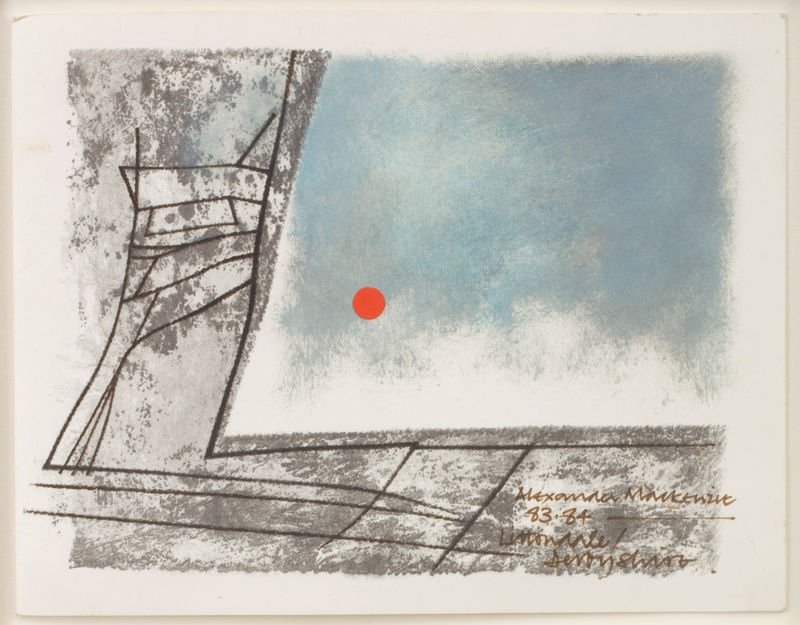
Alexander Mackenzie (1923-2002) was a pivotal figure within the second generation of the St Ives School, known for his thoughtful, structurally attuned approach to landscape abstraction. Born in Liverpool in 1923, Mackenzie served in the army during the Second World War before studying at Liverpool College of Art under the exiled German painter Martin Bloch. Bloch’s emphasis on colour, light, and expressive composition left a lasting impact on Mackenzie, encouraging a sensibility that bridged Continental modernism and the emerging British abstraction of the postwar period.
Mackenzie moved to Cornwall in 1950, drawn by the presence of artists such as Peter Lanyon, Bryan Wynter, and Patrick Heron. Although he shared their immersion in the Cornish landscape, Mackenzie developed a quieter, more meditative visual language than many of his contemporaries. His paintings rarely present direct observation; instead, they distil landscape into interlocking planes, rhythmic geometries, and atmospheric tonal gradations. Edges are softened, forms are reduced, and subtle transitions in colour suggest shifting weather, geological strata, and the slow passage of time.
His technique involved building up surfaces gradually — often with thin, layered washes that allowed underglow and tonal resonance to emerge. This process created works that feel suspended between drawing and painting, solidity and dissolution. While rooted in the natural environment around Penzance, Mackenzie was less concerned with topographical specificity than with conveying an internalised landscape, one shaped by memory, rhythm, and contemplative attention.
Throughout the 1950s and 1960s, Mackenzie became a regular exhibitor with the Penwith Society of Arts, the Newlyn Society of Artists, and at leading London galleries, including the prestigious Redfern Gallery. His inclusion in major surveys of British abstraction affirmed his position as a key contributor to postwar modernism. He represented British painting in several international touring exhibitions, helping to broaden awareness of the St Ives movement beyond the UK.
In 1959, Mackenzie joined the staff of Plymouth College of Art, where he would teach for nearly three decades, eventually becoming Head of Fine Art. His influence as an educator was considerable: he encouraged generations of students to engage thoughtfully with structure, process, and disciplined experimentation. Many artists who passed through Plymouth recall Mackenzie as a generous, rigorous mentor whose nuanced understanding of modernist principles shaped their development.
Mackenzie’s works are represented in major public collections, including Tate, the Arts Council Collection, the Government Art Collection, and numerous regional museums. His paintings of the 1970s and 1980s show a further refinement of his visual language, with increasingly reduced forms, subtle tonal shifts, and a deepening sense of spatial calm. He continued to work from his home in Cornwall until his death in 2002.
Although sometimes overshadowed by more flamboyant figures of the St Ives School, Mackenzie’s contribution is significant and enduring. His paintings embody a modernist commitment to structure and clarity, balanced by a lyrical sensitivity to place. In their quiet authority and understated beauty, they offer a distinct vision of the Cornish landscape — one filtered not through expressive theatrics, but through thoughtful, sustained attention to form, time, and the inner life of the painter.